Hi guys, this is the last blog post. I am grateful for the people who have participated in the comments. I hope the blog has been some of use to you and has been a way informative about the topic of digital marketing.
I may still post regularly from now on, on topics of digital marketing in general and some daily feeds but the discussion points will no longer be guided by the points in class.
In the age of big data, customers are becoming more and more aware of their privacy issues.
The realization that nothing is for free!
And they demand greater actions from companies to protect consumer rights. Unfortunately this is not in the companies’ best interest. This presents a very controversial debate because while on one hand we have people who want to raise awareness of their rights of ownership and control, on the other the facilitation of such would also mean that consumer rights are significantly compromised.
Companies such as Google, Facebook and Twitter feel it is not their best interest to care about consumer rights because their core purpose as a social media platform is to facilitate the exchange of data, and to make money. Therefore they are willing to man-oeuvre in whatever way they can around existing laws as long as it benefits the core values of the company in the long run. Facebook, for example has on many occasions tried to dodge accusations of privacy issues.
Facebook in court.
Mark Zuckerberg was grilled on Tuesday over Facebook's ongoing data, privacy, and information scandals.
A standout line of questioning came from Sen. Dick Durbin, who challenged Zuckerberg about his comfort level with his own personal information.
“If you’ve messaged anyone this week, would you share with us the names of the people you’ve messaged?” Durbin added and Zuckerberg responded, “No, I would probably not choose to do that publicly here.”
In the face of these issues, the EU has decided to put up its own laws (Articles 11 & 13) to stop the exploitation of customer data. It introduces a form of copyright with the digital content that is similar to the physical copyright we are familiar with- dictating that, no user, company or content creator should be able to use links, soundtrack or other user information without original up-loader’s consent. Whilst this would put a cap on company’s exploitation of customer data, it would also significantly reduce consumer freedoms.
Article 13 specifically enables social media platforms to ‘police’ their sites through the use of filters. Whilst this shouldn’t have an effect on what people can or cannot see, it will put a restraint on the format of information people are allowed to put online. Especially in the case of digital marketing, it is suspected that marketing costs would rise. Perhaps the cheaper alternative of micro-influencers would not work out and it would significantly change the ways companies could reach their customers.
So who is the benefactor at the end of the spectrum? The customers who need protection and are subjected to the law and its obligation (the small artists and content creators), or companies who has greater power and control to man-oeuvre around the law? Small businesses will suffer significant losses because of their inability to compete with their better equipped counter parts.
What are we to do?
Of course, you can argue that we can deactivate or social media accounts and cut all ties with any connections of media, but that is not possible. It is human nature that we connect, and in the present age, connection comes at a cost. But it does not mean we should turn away. Whilst we can say Article 13 is a good beginning, more changes to it would be necessary to make sure the law benefits consumers, users and content creators, as much as companies.
For now just focus on using Facebook whilst not letting it use you.
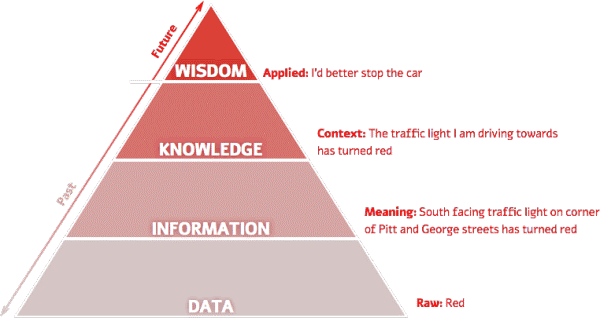
The possibilities we can create using big data are vast. The compromise of information also has its negative impacts. When we look at data, data is really by itself meaningless but it is the way we choose to use it that creates meaning.
The DIKW model of data information hierarchy shows data is only of use when it is processed into information. This information is then used on different contexts. We cannot change how people will use information, but we can also argue that it does have wide ranging benefits.
The dilemmas we face with the compromise of personal information will always exist from the beginning of the digital age to the end and it will only be exemplified with the introduction of ‘internet of things’; however, so will the gains.
The internet of things will make daily tasks more convenient
to us as a whole and it would make people more attuned to themselves and their needs,
and to take charge of their wellbeing. The power of data is in its ability to
predict and that it knows us better than we know our selves.
With the introduction of the ‘internet of things’ it could
be possible that everything can be turned into a tool for communication or a
tool for human benefit.
Imagine scanning the natural environment through the camera of a smart phone and know immediately who has been there, what are their opinions of the place and what has happened.
Doramon is a manga series created by Japanese artist under the pseudonym Fujiko Fujio. Doramon is a robot cat that pulls out futuristic gadgets from his pockets to help the boy Nobita Nobi.
One of the novelties I remember from the series is the memory bread, which you press upon a page of information and which allows you to remember everything upon consumption. A perfect snack for the exams 🙂
In another instance, the character Nobi sent a mail to his friend by drawing out a rough proximity of locations on the pad and sticking it to the back of a teddy bear , the bear is able to follow commands and deliver the parcel to indicated locations.
The internet of things enable us to transmit data and information without the need of human to human interaction. In the future where objects, animals or people that are provided with unique identifiers and has the ability to transfer data over a network , the world envisioned by Fujio in his anime series could be closer to reality.
With all said.
Big data provides us with many possibilities, but it also means information definitely should be better regulated with the provision of the big data economy. Effective risk management in terms of big data is associated with the three factors: secure, vigilant and resistant. As with all concepts before getting into something we have to decide what is safe for us. Big Data and the internet of things has its benefits but all that depends on how we use it.
Mobile social media marketing has really opened up the global economy and changed the ways people interact. The prevalence of social media, has enabled people to keep in touch, people to people, from one side of the world to the other. The new information which opens us to the world and are critical for us to connect are just a tap of the finger away.
However,
Ubiquitous of the mobile device has enabled companies to
reach customers anywhere and at any time.
Some people may have liked this feature but I always find that a little annoying.
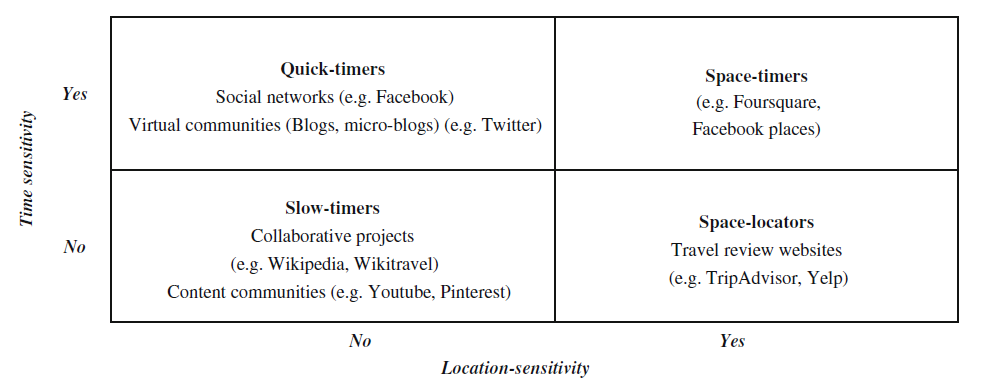
Social media has opened up the global economy in the we interact. But as Kaplan discussed his time and space model, I also wondered, about the alternative effects. Is ‘space timers’ really the way to go?
Mobile marketing would open up a world of new possibilities
for companies and consumers, however companies would also need to carefully
integrate their activities to avoid being a nuisance.
Whilst mobile usage has grown in the large number of BRIC countries ( Brazil, Russia, India, China) and mobile marketing has been the main proponent of reach and market penetration (Kaplan,2012), however a growing number of customers are becoming wary of commercialized marketing.
The 4 Is of Social Media Marketing
I thought a good campaign should aim to engage not disrupt and below I will explain using the Britney example of how to capture customer attention using the 4 I’s of social media.
Kaplan 2012, has used the model to illustrate that the correct way of using mobile social media marketing would be to:
Take account of user preferences and interest (Individualization). This would have been easy with the Britney campaign, as it would have been targeted at fans with high degrees of consumer knowledge (Kaplan 2010.) It utilities a pull strategy to draw people in.
Integrate your activities into your user’s life to avoid being a nuisance. Britney has done well in this regard as the campaign involves a follow up of the tour in a causal and lighthearted message tone.
Initiate the creation of user generated content. By- constantly updating customers about the tour, Britney has also given her fans something to talk about.
Involve the user through engaging conversations which was the point of the message. Delivering the updates through the form of a text message means that the celeb can communicate with customers as if they were friends. This also leaves more room for a buzz. Customer generated content has been proven to be way more effective that firm generated content. The act also enables a closer sense of connection between them.
To conclude, social media has obviously changed lives, and, it is exciting to see where the future would lead from here. I believe the constructive use of social media would avoid the threshold of consumer dissatisfaction.
A truly successful campaign
should have the following qualities:
Engage not disrupt
Deliver a cause.
Relevance
And more importantly it should aim to shape customer decision making and thinking process through a series of micro-moments. (Veyna, 2019)
Hope you Enjoyed.
Reference:
Kaplan, Andreas M. “If You Love Something, Let It Go Mobile: Mobile Marketing and Mobile Social Media 4×4.” Business Horizons 55.2 (2012): 129-39. Web.
Today we are examining the concept how how ideas spread by comparing the theories of Jonah Berger, Malcom Gladwell and Seth Godin.
Gladwell says there is a time for everything, followed by a tipping point (not because that the product stood out, but because it has been there for enough time, for people to take notice. i.ie the Fax machines.
Berger indicates that there are messages we can incorporate to help the idea spread. i.ie triggers, stories, ect to add another layer to the original context of meanings.
Godin suggests the purple cow. You can’t be good or mediocre but you need to be on the edge.
My perception is: Concepts can be used as references but we learn about marketing from our environments and surroundings by observing the present. So what I said early during our discussion there is no absolute- truth. And the example with about the surgery and surgeons. I am sure he learned it through practice. but what he does that is just his practice. Everybody can derive different experience from his/her practice. But to be a good surgeon one just needs to learn how to hold a scalpel. What I don’t get with the discussion why do we have to make it so philosophical when a majority of it is common sense. All there authors just presented different views of dealing with the situation through their experience, so what is the right or wrong is basically based on their opinions. All of them may be right or all of them may not be right, depending on the situation you apply it to there are always rooms for disputes. The only thing constant about marketing is probably the fact nothing is constant, because marketing is always at the heart of change (innovation.) And even if we put two similar looking situations together there are probably still different, like the shape of lines on a person’s hand or patterns on a zebra. So I don’t think there is one concept that applies to social media marketing at all times. Application of marketing calls for a technical approach not philosophical.
I am a Marketing student at RMIT with an interest in design and fashion. After looking through some sites, I have made the bold decision to create/design a website. I will use this blog to document and share some of the ideas and concepts along the way.
I have always thought that interfaces should be as ergonomic and simple as possible. In my research, I have found company websites can be both tech and design focused. Some favor one side over the other.
A good interface should facilitate interaction; it needs to be complex enough to meet the technical functions but that of which is displayed to the customer should be simple and engaging. In the following I will discuss how design elements can be used in collaboration with social media marketing to create a seamless customer experience.
Simplicity has great importance in the assessment of great design and how people take in information. Below I will mention the core design principles that I think will help content creators.
Design Principles
In creation of the web-page it is possible to consider the various elements of design.
Colour– nature has all our colour pallet. The key is keeping it simple. Here is a link flat-design that speaks about ‘flat designing and the use of two dimensional elements and bright colours to guide customers through the computer screen.
Dots and Landscape– it is possible for content creators to draw inspirations from the elements that already exist in nature. From research, I have found that simple elements such as dots and nature can be manipulated in such a manner to provide the desired consumer experience. Images can be used to guide the eye or create a relaxed reading atmosphere.
Another method that is commonly seen used also is the ‘F’ design. This is where the display of context is laid out in a manner according to the viewer’s natural intake of visual material (from left to right and top to bottom.)
Apple is a good example of company whose website considers both of these principles.
That is all. What are your opinions? Hope to hear more from you and if you wish to see progress with the web design, please subscribe and keep track.
Hi everyone, welcome to my first blog. This blog has been written for RMIT’s Digital Marketing unit MTKG1053. Each week I will post updates and discussions from the unit.
Some background about myself:
HI THERE
I am a third year marketing student from RMIT.
I am really looking forward to this unit. I love discussing marketing and especially its implementations in the digital world. Let’s get to know each other.







 The Marketing Journal